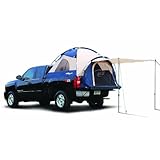
Chinook Twin Peaks Guide Fiberglass Expedition Tents 6 Person Plus 2 Doors Height 6.75FT New Review

Chinook Twin Peaks Guide Fiberglass Expedition Tents 6 Person Plus 2 Doors Height 6.75FT New
Average Reviews:

(More customer reviews)
The first time setting this up (in our garage), it took my husband and I only 30 minutes to set up the tent, and another 30 minutes to set up the fly.The directions were decent, but they don't tell you that it is color-coded which helps. The direction on the fly is incorrect - you need to place the spine pole of the fly into the web pockets before you drape it over the tent.

Very roomy with plenty of ventilation.We placed ours on a light tarp that was a very close footprint of the tent itself.

It is probably a known item to frequent campers, but having only used the very small tents, it took us a few minutes to figure out what the toggles were for inside and outside the tent (securing the rolled up unzipped divider).Velcro tabs on the fly to hold it on the poles were also designed but not in the directions.

We'll be camping with it this weekend with some rain in the forecast and I hope to have a follow-up review. The zippers seem well-made with velcro fastners to keep the elements out.

Click Here to see more reviews about: Chinook Twin Peaks Guide Fiberglass Expedition Tents 6 Person Plus 2 Doors Height 6.75FT New

Product Description:
Featuring another innovative design concept in family/group tents: Chinook's InterDome, a 2 tent-in-1 system, for double the living space.One very roomy sleeping dome, plus a functional and practical screened dome with a removable heavy-duty floor will make you the envy of the campground.Features: Extremely large screened dome is big enough to fit a picnic table;Both Interdome rooms have plenty of headroom with peaks that are 6'6" high;Heavy duty, oxford nylon floor on main dome will stand up to repeated camp cot and foot traffic;Very durable PE floor on the screened dome can be removed if necessary;Two large doors on the fly double as sun and rain awnings;Extra long tent fly has delta panels to help keep rain well away from the tent floor and body;Designed for a quick and easy set-up so you can enjoy the great outdoors faster.Specifications: Capacity: 6 person +;Fiber Glass poles tent weight: 28 lbs 8 oz (12.9 kg);Poles: 4 + ridgepole;Doors: 2 doors;Height: 6'9" (206 cm);Floor: 13'8" x 9'4" (417 x 285 cm);Body area: 128 ft2 (11.9 m2);with vestibule area: 142 ft2 (13.2 m2);3 season.

Buy NowGet 35% OFF

Want to read more honest consumer review about Chinook Twin Peaks Guide Fiberglass Expedition Tents 6 Person Plus 2 Doors Height 6.75FT New now ?

MSR Hubba HP Solo Tent Review

MSR Hubba HP Solo Tent
Average Reviews:

(More customer reviews)
Lightweight and well made. Too narrow and low for my 6'2" frame. Sweet tent if you fit.

Click Here to see more reviews about: MSR Hubba HP Solo Tent

Product Description:
To create the Hubba HP, MSR took the ultimate free-standing solo tent, added greater coverage to the tent canopy and updated it with lighter fabrics all-around. The result is a tent that not only performs better in more challenging conditions, but actually weighs less too. And less mesh and more fabric in tent body means more protection for spring, fall and alpine environments.
The Hubba HP has an all-in-one hub and swivel pole design that's strong under tough weather conditions and is extremely simple to use. This versatile tent can be used as a double-wall tent for full protection or in two, freestanding tarp modes when used with optional footprint (sold separately). It features a high-tech ripstop nylon rainfly that reduces weight and a silicon and polyurethane coating that increases durability and resistance to damaging UV rays.
Its Dry Entry entrance design ensures water won't drip into the tent when doors are opened for ventilation in rainy weather. Other features include a 40D ripstop nylon floor for excellent protection from water, taped seams, welded reinforcements, reflective guy cords, and user-friendly door toggles.


Hubba HP floor plan.

Hubba HP height.
Specifications:

    Capacity: 1
    Weight: 2 pounds, 9 ounces
    Floor dimensions: 17 square feet
    Vestibule: 9 square feet
    Interior peak height: 40 inches
    Packed size: 20 x 6 inches
    Doors: 1

About MSR
Mountain Safety Research (MSR) designs, manufactures, and markets innovative adventure gear for outdoor enthusiasts. The ever-growing MSR product line is most popular with mountaineers, backpackers, and campers. MSR is the industry leader in reliability and quality with every product it focuses on--tents, stoves, water filters, snowshoes, cookware, climbing gear, fuel, and related accessories. All of MSR's products set the benchmark in performance throughout the specialty outdoor industry. MSR is also one of the most widely distributed brands in the outdoor industry and provides products to more than 1,200 specialty retailers in North America and export to more than 30 countries.
MSR Materials & Workmanship Guarantee
MSR warranties the materials and workmanship in every MSR tent to the original owner. If your MSR tent has received proper care, but fails due to a defect in manufacturing, the tent will be repaired or replaced at MSR's discretion. Repairs due to accident, improper care or negligence where MSR is not at fault--including sun degradation, mildew, wear and tear due to hard use--will be performed at a reasonable charge. MSR offers a lifetime warranty to the original owner on all MSR tent framework. If your tent pole breaks, MSR will repair or replace it--free--for the lifetime of the tent, upon postage paid delivery to the MSR Product Service Center. This warranty applies only to the original purchaser. Proof of purchase is required.
Amazon.com Tent Guide
Selecting a Tent
Fortunately, there are all kinds of tents for weekend car campers, Everest expeditions, and everything in-between. Here are a few things to keep in mind:
Expect the Worst
In general, it's wise to choose a tent that's designed to withstand the worst possible conditions you think you'll face. For instance, if you're a summer car camper in a region where weather is predictable, an inexpensive family or all purpose tent will likely do the trick--especially if a vehicle is nearby and you can make a mad dash for safety when bad weather swoops in! If you're a backpacker, alpine climber or bike explorer, or if you like to car camp in all seasons, you'll want to take something designed to handle more adversity.
Three- and Four-Season Tents
For summer, early fall and late spring outings, choose a three-season tent. At minimum, a quality three season tent will have lightweight aluminum poles, a reinforced floor, durable stitching, and a quality rain-fly. Some three-season tents offer more open-air netting and are more specifically designed for summer backpacking and other activities. Many premium tents will feature pre-sealed, taped seams and a silicone-impregnated rain-fly for enhanced waterproofness.
For winter camping or alpine travel, go with a four season model. Because they typically feature more durable fabric coatings, as well as more poles, four-season tents are designed to handle heavy snowfall and high winds without collapsing. Of course, four-season tents exact a weight penalty of about 10 to 20 percent in trade for their strength and durability. They also tend to be more expensive.
Domes and Tunnels
Tents are broadly categorized into two types, freestanding, which can stand up on their own, and those that must be staked down in order to stand upright. Freestanding tents often incorporate a dome-shaped design, and most four-season tents are constructed this way because a dome leaves no flat spots on the outer surface where snow can collect. Domes are also inherently stronger than any other design. Meanwhile, many three-season models employ a modified dome configuration called a tunnel. These are still freestanding, but they require fewer poles than a dome, use less fabric, and typically have a rectangular floor-plan that offers less storage space than a dome configuration. Many one and two-person tents are not freestanding, but they make up for it by being more lightweight. Because they use fewer poles, they can also be quicker to set up than a dome.
Size Matters
Ask yourself how many people you'd like to fit in your fabric hotel now and in the future. For soloists and minimalists, check out one-person tents. If you're a mega-minimalist, or if you have your eye on doing some big wall climbs, a waterproof-breathable bivy sack is the ticket. Some bivy sacks feature poles and stake points to give you a little more breathing room. Also, if you don't need bug protection and you want to save weight, check out open-air shelters.
Families who plan on car camping in good weather can choose from a wide range of jumbo-sized tents that will accommodate all your little ones with room to spare. A wide range of capacities is also available for three- and four-season backpacking and expedition tents. Remember, though, the bigger the tent you buy, the heavier it will be, although it's easy to break up the tent components among several people in your group. It's also helpful to compare the volume and floor-space measurements of models you're considering.


Buy Now

Want to read more honest consumer review about MSR Hubba HP Solo Tent now ?

Big Agnes Copper Spur UL2 Ultra Light Tent: 2-Person 3-Season Review

Big Agnes Copper Spur UL2 Ultra Light Tent: 2-Person 3-Season
Average Reviews:

(More customer reviews)
I purchased a Big Agnes Fly Creek 2 from HumbleOutdoors for about $310, the price included a free BA Footprint and free delivery.

The tent performed well in Maine's 100 mile wilderness segment of the AT.
It is simple to set up and well built. The material is light and thin, but apparently of high quality. I would definitely recommended using the BA footprint. This was a solo trip, but the tent could have easily accommodated two people. On my one rainy evening, the tent performed well through a weather system that dropped two inches of rain, and had a 30 minute period of intense wind. Thumbs up for the Fly Creek, it has now replaced my venerable Sierra Designs Clip Flashlight of 22 years.

Click Here to see more reviews about: Big Agnes Copper Spur UL2 Ultra Light Tent: 2-Person 3-Season

Product Description:
Planning a weeklong backpacking trip into the high country? Keep your pack weight low?carry the Big Agnes Copper Spur Ultra Light Tent. Yet you won't have to give up space and comfort to go light: The Copper Spur has two doors and two vestibules so no one has to crawl over the other person's sleeping area, and you have plenty of room to shelter packs and pooches from the elements. This two-person, three-season tent features tent-pole-making company DAC's latest technology in lightweight, durable tent poles. DAC made these poles for the Copper Spur with an eco-friendly process that eliminates the need for two toxic chemicals and that recycles wastewater. These aluminum poles fit together using Big Agnes' hub-pole system to make setup fast and easy.

Product Features

    Material: [Fly & Floor] nylon ripstop with PU coating; [Body] ultra light nylon & polyester mesh
    Freestanding: Yes
    Poles:
    Pole Material: DAC Featherlite NSL aluminum
    Doors: 2
    Clip / Sleeve: Clip
    Floor Space: 90 x 42-52in (229 x 106.7-132cm), 29sq ft (2.7sq m)
    Interior Height: 42in (106.7cm)
    Vestibule Space: 18sq ft (1.7sq m)
    Packed Size: 7 x 20in (17.8 x 51cm)
    Seam Sealed: Yes
    Ventilation: Mesh top, partial mesh sides
    Weight: 3lb 6oz (1531g)
    Recommended Use: 3-Season ultra light backpacking
    Manufacturer Warranty: Lifetime
    Country of Origin: China


Buy NowGet 1% OFF

Want to read more honest consumer review about Big Agnes Copper Spur UL2 Ultra Light Tent: 2-Person 3-Season now ?

Eureka Timberline Outfitter 6 10' 3" by 8' 6" Six-Person Tent Review

Eureka Timberline Outfitter 6 10' 3' by 8' 6' Six-Person Tent
Average Reviews:

(More customer reviews)
I needed to replace my car camping/kick around tent,which was an 18 yr. old Timberline 4. The Timberline design is about as fast and easy setup as it gets,and all things considered, not bad stability. The new outfitter 6 is a step up as it has stronger materials and two doors. I am 6'2" and have headroom to stand up straight. This is a luxurious walk in,A-frame cabin tent for 2,with a ton of gear and cots! It will comfortably sleep 4 or 5,(6 in a pinch). The only reason I did not give it 5 stars is Eureka only put 2 mesh pockets in a tent this size(why not 4 or 6 ?). Also the heavy, awkward, hard to use metal clips that attach the body to the fly could have been nylon/fastex. I highly recommend this tent for car camping, basecamp,even some canoe camping.

Click Here to see more reviews about: Eureka Timberline Outfitter 6 10' 3 by 8' 6 Six-Person Tent

Product Description:
One of the world's most popular tents (with over a million sold), the classic A-frame Eureka Timberline Outfitter 4 offers room enough for four sleepers and an industrial, heavy duty design. Ideal for car campers or using as a base camp, the three-season free-standing Outfitter 4 will stand up to the toughest of conditions. Set up is quick and easy, thanks to a sturdy shockcorded 0.5-inch aluminum frame, ring and pin attachments, and clip attachments.
It features a breathable nylon wall, polyester fly, and a heavy-duty bathtub floor made of 4 ounce 210D oxford nylon that repels water. The High/Low door vents from the top and/or bottom, providing options for moderating air flow. The hooded fly at the front and rear allows windows to remain partially open during rain for ventilation. Shockcorded eaves increase stability and tear resistance in wind. Other features include two mesh gear pockets, loops for gear loft, flashlight, and clothes line, and closable windows.
Specifications:

    Area: 87 square feet
    Floor size: 10 feet, 3 inches by 8 feet, 6 inches
    Center height: 6 feet, 3 inches
    Wall fabrics: 1.9-ounce breathable nylon/ 1.9-ounce permeable taffeta nylon
    Floor fabrics: 4-ounce oxford nylon with 1200mm coating
    Fly fabrics: 2.2-ounce 75D Ripstop polyester with 1500 mm coating
    Pack size: 8 by 30 inches
    Weight: 18 pounds, 8 ounces

About Eureka
Though the exact year is unknown, Eureka's long history begins prior to 1895 in Binghamton, New York, where the company still resides today. Then known as the Eureka Tent & Awning Company, its first wares were canvas products--most notably, Conestoga wagon covers and horse blankets for nineteenth century American frontiersmen--as well as American flags, store awnings, and camping tents.
The company increased production of its custom canvas products locally throughout the 1930s and during the 1940 and even fabricated and erected the IBM "tent cities" just outside Binghamton. The seven acres of tents housed thousands of IBM salesmen during the company's annual stockholders meeting, which had since outgrown its previous locale. In the 1940s, with the advent of World War II and the increased demand for hospital ward tents, Eureka expanded operations and began shipping tents worldwide. Ultimately, upon the post-war return of the GIs and the resultant housing shortage, Eureka turned its attention to the home front during the 1950s by supplying awnings for the multitude of mobile homes that were purchased.
In 1960, Eureka's new and innovative Draw-Tite tent, with its practical, free standing external frame, was used in a Himalayan Expedition to Nepal by world renowned Sir Edmund Hillary, the first person documented to summit Mt. Everest only six years earlier. In 1963, Eureka made history during its own Mt. Everest ascent, with more than 60 of its tents sheltering participants from fierce 60+ mph winds and temperatures reaching below -20°F during the first all American Mt. Everest Expedition.
For backpackers and families, Eureka introduced its legendary Timberline tent in the 1970s. Truly the first StormShield design, this completely self-supporting and lightweight backpacking tent became one of the most popular tents the entire industry with sales reaching over 1 million by its ten year anniversary.
Eureka tents have also traveled as part of several historic expeditions, including the American Women's Himalayan Expedition to Annapurna I in 1978 and the first Mt. Everest ascents by a Canadian and American woman in 1986 and 1988. In recent history, tents specially designed and donated by Eureka sheltered Eric Simonson and his team on two historic research expeditions to Mount Everest, this time in a quest for truth regarding the 1924 attempted summit of early English explorers George Mallory and Andrew Irvine. During the 1999 expedition, the team made history finding the remains of George Mallory, but the complete mystery remained unsolved. Returning in 2001 to search for more clues, the team found amazing historical artifacts which are now on display at the Smithsonian.
Amazon.com Tent Guide
Selecting a Tent
Fortunately, there are all kinds of tents for weekend car campers, Everest expeditions, and everything in-between. Here are a few things to keep in mind:
Expect the Worst
In general, it's wise to choose a tent that's designed to withstand the worst possible conditions you think you'll face. For instance, if you're a summer car camper in a region where weather is predictable, an inexpensive family or all purpose tent will likely do the trick--especially if a vehicle is nearby and you can make a mad dash for safety when bad weather swoops in! If you're a backpacker, alpine climber or bike explorer, or if you like to car camp in all seasons, you'll want to take something designed to handle more adversity.
Three- and Four-Season Tents
For summer, early fall and late spring outings, choose a three-season tent. At minimum, a quality three season tent will have lightweight aluminum poles, a reinforced floor, durable stitching, and a quality rain-fly. Some three-season tents offer more open-air netting and are more specifically designed for summer backpacking and other activities. Many premium tents will feature pre-sealed, taped seams and a silicone-impregnated rain-fly for enhanced waterproofness.
For winter camping or alpine travel, go with a four season model. Because they typically feature more durable fabric coatings, as well as more poles, four-season tents are designed to handle heavy snowfall and high winds without collapsing. Of course, four-season tents exact a weight penalty of about 10 to 20 percent in trade for their strength and durability. They also tend to be more expensive.
Domes and Tunnels
Tents are broadly categorized into two types, freestanding, which can stand up on their own, and those that must be staked down in order to stand upright. Freestanding tents often incorporate a dome-shaped design, and most four-season tents are constructed this way because a dome leaves no flat spots on the outer surface where snow can collect. Domes are also inherently stronger than any other design. Meanwhile, many three-season models employ a modified dome configuration called a tunnel. These are still freestanding, but they require fewer poles than a dome, use less fabric, and typically have a rectangular floor-plan that offers less storage space than a dome configuration. Many one and two-person tents are not freestanding, but they make up for it by being more lightweight. Because they use fewer poles, they can also be quicker to set up than a dome.
Size Matters
Ask yourself how many people you'd like to fit in your fabric hotel now and in the future. For soloists and minimalists, check out one-person tents. If you're a mega-minimalist, or if you have your eye on doing some big wall climbs, a waterproof-breathable bivy sack is the ticket. Some bivy sacks feature poles and stake points to give you a little more breathing room. Also, if you don't need bug protection and you want to save weight, check out open-air shelters.
Families who plan on car camping in good weather can choose from a wide range of jumbo-sized tents that will accommodate all your little ones with room to spare. A wide range of capacities is also available for three- and four-season backpacking and expedition tents. Remember, though, the bigger the tent you buy, the heavier it will be, although it's easy to break up the tent components among several people in your group. It's also helpful to compare the volume and floor-space measurements of models you're considering.


Buy NowGet 11% OFF

Want to read more honest consumer review about Eureka Timberline Outfitter 6 10' 3 by 8' 6 Six-Person Tent now ?

Sportz Truck Tent III Review

Sportz Truck Tent III
Average Reviews:

(More customer reviews)
I just bought one of these tents a couple of weeks ago.The setup took about 20 minutes and then another 10 minutes for the canopy.The tent goes up just like any other popup tent with the fiberglass poles.The tent holes are color coded to the poles so that was a plus.The setup for the middle (inside) pole (that runs across the roof on the inside) was a little awkward because you had to be in the tent to set it up.

3 gripes/cons:

1. The tent should have a padded floor to pad you and your knees from the hard metal truck bed.It would be fairly easy to make some sort of insert/pocket for placing padding in the bottom.

2. The door for the tent is difficult to zip shut at the corner due to the high amount of tension from the arching support pole.I had to unclip the hangar clip from the pole to get the door to zip shut.Unclipping the hangar clip is a 1/2 second task that easily corrects the zipper issue.

3. The canopy could be design a little better to handle rain.My canopy would pool rain water that had to be dumped.It would have been better designed by having a rainfly type pole support system.This support would keep the canopy stiff and the water would run off.

Pros:

1. Keeps you off the ground (great for rainy weather.)
2. Tent shape is very open inside so there's lots of room to move around inside.
3. Excellent ventilation.
4. Neat little 'glove' type hole that allows you to reach into your truck's back window without having to expose your hand to the outside (great for when it's raining.)

It just so happens that it rained the first night I took this tent out.The rainfly and the tent kept me dry and waterproof.

Overall - an excellent tent.

Click Here to see more reviews about: Sportz Truck Tent III

Product Description:
Why camp in an ordinary ground tent or an expensive RV, when you can camp right in the back of your truck.The Sportz Truck Tent III assembles in the back of your open-bed pickup in 10 minutes, creating a comfortable, restful sleeping area for two people with over 5.5 ft. of headroom. With its patented sewn in floor, you won't have to worry about cleaning out your bed before using it.

Buy Now

Want to read more honest consumer review about Sportz Truck Tent III now ?

Eureka Assault Outfitter 4 8.5-Foot by 7.5-Foot Four-Person Tent Review

Eureka Assault Outfitter 4 8.5-Foot by 7.5-Foot Four-Person Tent
Average Reviews:

(More customer reviews)
The Assault Outfitter is a great tent; it is made better than the standard tent, and is certainly up to 'expedition duty' quality. It is also roomy for this type of tent, with plenty of room for two large people and associated gear..and lots of gear, making this a true four-season tent.
It has been noted in another review that this is 'not a backpacking tent'; I would argue that it depends on your definition of backpacking. To me, it IS a backpacking tent. If I'm out for a week or more in rugged conditions, frankly, I want a bit more than the average ultra-light backpacking tent offers. No, you won't want to stuff this in your average weekend internal frame pack; not because you can't handle 13 lbs, but because it is bulky. However, if you're old school like me, and use a large external frame pack, like the Kelty Super Tioga, it will swallow this tent up with ease, and pack quite comfortably. Add a few quality compression straps to this, and break it down and distribute the load amongst two or three backpackers, and it becomes even more 'backpack-able'. I'll admit that I'm an old light-infantryman, used to packing sixty-eighty lbs for weeks on end, so 13 lbs of reliable and comfortable living space on my back is a non-issue. If you're an ultra-light minimalist, and want to backpack with only a fanny pack and three matches, this is not the tent for you.
I would add that if you're the type that keeps a 'bug-out rucksack' on standby, this is a great tent to have stuffed inside of it, as it is built heavily enough for serious and extended duty.
If I could only own one tent (and I own several), this would be the one that I kept.

Click Here to see more reviews about: Eureka Assault Outfitter 4 8.5-Foot by 7.5-Foot Four-Person Tent

Product Description:
Modeled after tents Eureka makes to shelter the military, the 4-season Eureka Assault Outfitter 4 can withstand the punishment of blowing sand, tropical storms and arctic cold. This three-pole rectangular dome tent sleeps up to four, and its streamlined shape easily sheds snow and heavy rain. The double-point front vestibule features UV and cold resistant window and is bottom venting; a single-point rear vestibule vents left, right, or rolls completely open.
It features a has a heavy-duty bathtub floor made of 210D oxford nylon that repels water and a tough 75D Stormshield polyester ripstop fly with 1500mm coating. It's further strengthened by the pre-bent 13mm 6000 series aluminum frame (three poles). Other features include two doors with durable #10 zippers, High/Low windows in each door for improved ventilation, and a post and grommet assembly.
Specifications:

    Area: 63.75 square feet
    Floor size: 8 feet, 6 inches by 7 feet, 6 inches
    Center height: 4 feet, 8 inches
    Wall fabrics: 70D nylon ripstop
    Floor fabrics: 210D oxford nylon with 1200mm coating
    Fly fabrics: 75D Stormshield polyester ripstop with 1500mm coating
    Pack size: 8 by 25.5 inches
    Weight: 13 pounds, 5 ounces

About Eureka
Though the exact year is unknown, Eureka's long history begins prior to 1895 in Binghamton, New York, where the company still resides today. Then known as the Eureka Tent & Awning Company, its first wares were canvas products--most notably, Conestoga wagon covers and horse blankets for nineteenth century American frontiersmen--as well as American flags, store awnings, and camping tents.
The company increased production of its custom canvas products locally throughout the 1930s and during the 1940 and even fabricated and erected the IBM "tent cities" just outside Binghamton. The seven acres of tents housed thousands of IBM salesmen during the company's annual stockholders meeting, which had since outgrown its previous locale. In the 1940s, with the advent of World War II and the increased demand for hospital ward tents, Eureka expanded operations and began shipping tents worldwide. Ultimately, upon the post-war return of the GIs and the resultant housing shortage, Eureka turned its attention to the home front during the 1950s by supplying awnings for the multitude of mobile homes that were purchased.
In 1960, Eureka's new and innovative Draw-Tite tent, with its practical, free standing external frame, was used in a Himalayan Expedition to Nepal by world renowned Sir Edmund Hillary, the first person documented to summit Mt. Everest only six years earlier. In 1963, Eureka made history during its own Mt. Everest ascent, with more than 60 of its tents sheltering participants from fierce 60+ mph winds and temperatures reaching below -20°F during the first all American Mt. Everest Expedition.
For backpackers and families, Eureka introduced its legendary Timberline tent in the 1970s. Truly the first StormShield design, this completely self-supporting and lightweight backpacking tent became one of the most popular tents the entire industry with sales reaching over 1 million by its ten year anniversary.
Eureka tents have also traveled as part of several historic expeditions, including the American Women's Himalayan Expedition to Annapurna I in 1978 and the first Mt. Everest ascents by a Canadian and American woman in 1986 and 1988. In recent history, tents specially designed and donated by Eureka sheltered Eric Simonson and his team on two historic research expeditions to Mount Everest, this time in a quest for truth regarding the 1924 attempted summit of early English explorers George Mallory and Andrew Irvine. During the 1999 expedition, the team made history finding the remains of George Mallory, but the complete mystery remained unsolved. Returning in 2001 to search for more clues, the team found amazing historical artifacts which are now on display at the Smithsonian.
Amazon.com Tent Guide
Selecting a Tent
Fortunately, there are all kinds of tents for weekend car campers, Everest expeditions, and everything in-between. Here are a few things to keep in mind:
Expect the Worst
In general, it's wise to choose a tent that's designed to withstand the worst possible conditions you think you'll face. For instance, if you're a summer car camper in a region where weather is predictable, an inexpensive family or all purpose tent will likely do the trick--especially if a vehicle is nearby and you can make a mad dash for safety when bad weather swoops in! If you're a backpacker, alpine climber or bike explorer, or if you like to car camp in all seasons, you'll want to take something designed to handle more adversity.
Three- and Four-Season Tents
For summer, early fall and late spring outings, choose a three-season tent. At minimum, a quality three season tent will have lightweight aluminum poles, a reinforced floor, durable stitching, and a quality rain-fly. Some three-season tents offer more open-air netting and are more specifically designed for summer backpacking and other activities. Many premium tents will feature pre-sealed, taped seams and a silicone-impregnated rain-fly for enhanced waterproofness.
For winter camping or alpine travel, go with a four season model. Because they typically feature more durable fabric coatings, as well as more poles, four-season tents are designed to handle heavy snowfall and high winds without collapsing. Of course, four-season tents exact a weight penalty of about 10 to 20 percent in trade for their strength and durability. They also tend to be more expensive.
Domes and Tunnels
Tents are broadly categorized into two types, freestanding, which can stand up on their own, and those that must be staked down in order to stand upright. Freestanding tents often incorporate a dome-shaped design, and most four-season tents are constructed this way because a dome leaves no flat spots on the outer surface where snow can collect. Domes are also inherently stronger than any other design. Meanwhile, many three-season models employ a modified dome configuration called a tunnel. These are still freestanding, but they require fewer poles than a dome, use less fabric, and typically have a rectangular floor-plan that offers less storage space than a dome configuration. Many one and two-person tents are not freestanding, but they make up for it by being more lightweight. Because they use fewer poles, they can also be quicker to set up than a dome.
Size Matters
Ask yourself how many people you'd like to fit in your fabric hotel now and in the future. For soloists and minimalists, check out one-person tents. If you're a mega-minimalist, or if you have your eye on doing some big wall climbs, a waterproof-breathable bivy sack is the ticket. Some bivy sacks feature poles and stake points to give you a little more breathing room. Also, if you don't need bug protection and you want to save weight, check out open-air shelters.
Families who plan on car camping in good weather can choose from a wide range of jumbo-sized tents that will accommodate all your little ones with room to spare. A wide range of capacities is also available for three- and four-season backpacking and expedition tents. Remember, though, the bigger the tent you buy, the heavier it will be, although it's easy to break up the tent components among several people in your group. It's also helpful to compare the volume and floor-space measurements of models you're considering.


Buy NowGet 30% OFF

Want to read more honest consumer review about Eureka Assault Outfitter 4 8.5-Foot by 7.5-Foot Four-Person Tent now ?

Wenzel Grand Lodge 14- by 12-Foot, 8 Person Cabin Dome Tent Review

Wenzel Grand Lodge 14- by 12-Foot, 8 Person Cabin Dome Tent
Average Reviews:

(More customer reviews)
I love everything about this tent except the rainfly. It does not deflect rain. It collects it. My first tent collapsed under the weight of collected rain in the fly. The steel poles fractured & tore multiple holes through the tent sides. We did have flood conditions in that storm so I let it go to 'the not so normal heavy rains'. I really liked everything else about it so I ordered another one. It is very spacious, has sturdy fabric & can be set up by one person very easily. However, the new tent also endured a thunderstorm & continued to collect rain.The best thing to do in rain is unhook the fly from the fly poles & stake the fly directly to the ground. It has a straight line & works better. Now that I figured that out I love it, but, it was an expensive lesson.

Click Here to see more reviews about: Wenzel Grand Lodge 14- by 12-Foot, 8 Person Cabin Dome Tent

Product Description:
Designed for privacy, this cabin-style, 14-foot x 12-foot two-room dome tent with 86 inches of center head room accommodates eight campers and has a divider curtain to divide the tent into two rooms. Two D-style doors provide separate entries. A welded-polyethylene tub-style floor keeps out ground moisture. The tent is made of rugged, weather-resistant polyester with a polyurethane coating for reliability. A removable fly keeps out rain. Double-stitched, lap-feld seams provide a shingle effect to prevent moisture seepage. A rain-shingle layer on the tent's lower portion provides a watershed effect. Other weather-resistant details include thread, zippers, and webbing treated with water repellents. Six windows and roof are made of polyester mesh. A shockcorded steel frame provides stability and quick set-up. A loft stores gear. The tent has a carry weight of 47.2 pounds and comes with a 10-year warranty against defects.
Amazon.com Tent Guide
Selecting a Tent
Fortunately, there are all kinds of tents for weekend car campers, Everest expeditions, and everything in-between. Here are a few things to keep in mind:
Expect the Worst
In general, it's wise to choose a tent that's designed to withstand the worst possible conditions you think you'll face. For instance, if you're a summer car camper in a region where weather is predictable, an inexpensive family or all purpose tent will likely do the trick--especially if a vehicle is nearby and you can make a mad dash for safety when bad weather swoops in! If you're a backpacker, alpine climber or bike explorer, or if you like to car camp in all seasons, you'll want to take something designed to handle more adversity.
Three- and Four-Season Tents
For summer, early fall and late spring outings, choose a three-season tent. At minimum, a quality three season tent will have lightweight aluminum poles, a reinforced floor, durable stitching, and a quality rain-fly. Some three-season tents offer more open-air netting and are more specifically designed for summer backpacking and other activities. Many premium tents will feature pre-sealed, taped seams and a silicone-impregnated rain-fly for enhanced waterproofness.
For winter camping or alpine travel, go with a four season model. Because they typically feature more durable fabric coatings, as well as more poles, four-season tents are designed to handle heavy snowfall and high winds without collapsing. Of course, four-season tents exact a weight penalty of about 10 to 20 percent in trade for their strength and durability. They also tend to be more expensive.
Domes and Tunnels
Tents are broadly categorized into two types, freestanding, which can stand up on their own, and those that must be staked down in order to stand upright. Freestanding tents often incorporate a dome-shaped design, and most four-season tents are constructed this way because a dome leaves no flat spots on the outer surface where snow can collect. Domes are also inherently stronger than any other design. Meanwhile, many three-season models employ a modified dome configuration called a tunnel. These are still freestanding, but they require fewer poles than a dome, use less fabric, and typically have a rectangular floor-plan that offers less storage space than a dome configuration. Many one and two-person tents are not freestanding, but they make up for it by being more lightweight. Because they use fewer poles, they can also be quicker to set up than a dome.
Size Matters
Ask yourself how many people you'd like to fit in your fabric hotel now and in the future. For soloists and minimalists, check out one-person tents. If you're a mega-minimalist, or if you have your eye on doing some big wall climbs, a waterproof-breathable bivy sack is the ticket. Some bivy sacks feature poles and stake points to give you a little more breathing room. Also, if you don't need bug protection and you want to save weight, check out open-air shelters.
Families who plan on car camping in good weather can choose from a wide range of jumbo-sized tents that will accommodate all your little ones with room to spare. A wide range of capacities is also available for three- and four-season backpacking and expedition tents. Remember, though, the bigger the tent you buy, the heavier it will be, although it's easy to break up the tent components among several people in your group. It's also helpful to compare the volume and floor-space measurements of models you're considering.


Buy NowGet 22% OFF

Want to read more honest consumer review about Wenzel Grand Lodge 14- by 12-Foot, 8 Person Cabin Dome Tent now ?